
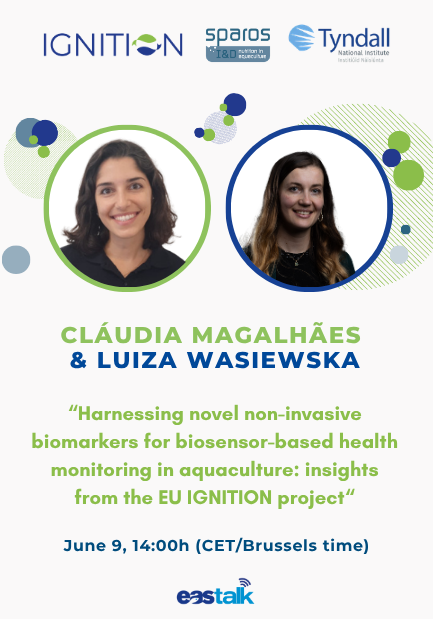
[ EAStalk ] Harnessing novel non-invasive biomarkers for biosensor-based health monitoring in aquaculture: insights from the EU IGNITION project
The rising global demand for animal protein and climate change stress aquaculture, making sustainable solutions that prioritize animal welfare crucial. In response, the IGNITION project explores innovative technological approaches to improve health and stress screening in key species, including European seabass, Atlantic salmon and rainbow trout. A core focus is identifying multilayer molecular signatures to assess fish response to challenges through omics technologies and their integration with machine learning to uncover novel biomarkers in minimally invasive biological matrices such as the skin mucus. To apply this practically, IGNITION is developing cutting-edge electrochemical biosensors, focusing on innovative miRNA-based biomarkers, for continuous, non-invasive monitoring, enabling real-time health surveillance and early interventions.
Short biography of the presenter(s):
Dr. Cláudia Raposo de Magalhães is a PhD researcher with expertise in molecular sciences, integrating multiomics, bioinformatics and biostatistics to improve fish nutrition, welfare and production efficiency in aquaculture. Her focus is on developing innovative non-invasive biomarker strategies, particularly through the fish skin-mucus interface with the objective of providing accurate signatures of fish performance. Currently she works as a Junior Scientific Researcher at SPAROS, Lda. and RIASEARCH, Lda., in Portugal, where she supports R&D activities integrating multiomics analyses, computational biology and statistical modelling to identify nutritional and physiological biomarkers relevant for aquaculture systems.
Dr. Luiza Wasiewska is a Research Ireland-funded Postdoctoral Fellow and Senior Researcher at the Tyndall National Institute. She combines her expertise in microbiology and biosensors to develop new diagnostic methods that could revolutionise how we detect and treat diseases. Her research focuses on alternatives to antibody recognition molecules which could be used not only to detect bacteria, but also other conditions, such as cancer, stress, or inflammation. In addition, she has a strong interest in sustainability and is researching the use of different sustainable materials (e.g. bioplastics) in the development electrochemical sensors.
Visit IGNITION's website: ignition-project.eu
Registration is mandatory, and you can register here for free.
NOTE:
- The EAStalk webinar will last 45 minutes. The presenter will give a 30-minute presentation, followed by a 15-minute live Q&A session. During the Q&A, you can interact with the presenter, by asking questions in the chat.
- The EAStalk webinar will be recorded, and the recording will be available on the EAS YouTube channel for one month. After that, it will only be accessible to EAS members under the 'EAStalk Webinars' section.
- All our EAStalk webinars and PDF's of the presentations since 2019 are available to EAS members on our website. If you're not a member, you can check the followinXg link for more information. We also offer free membership for retirees and students.
ABOUT
The series aims to present a wide range of topics that reflect the multidisciplinary nature of EAS and the broader aquaculture community. This includes overviews of aquaculture research, production, and technologies (including those from EAS corporate members), as well as presentations on our network and its benefits, with specific topics tailored for our large student community.